How to Write a CV for an Accounting or Finance Job in Kenya
KaziKit · 17 September 2026
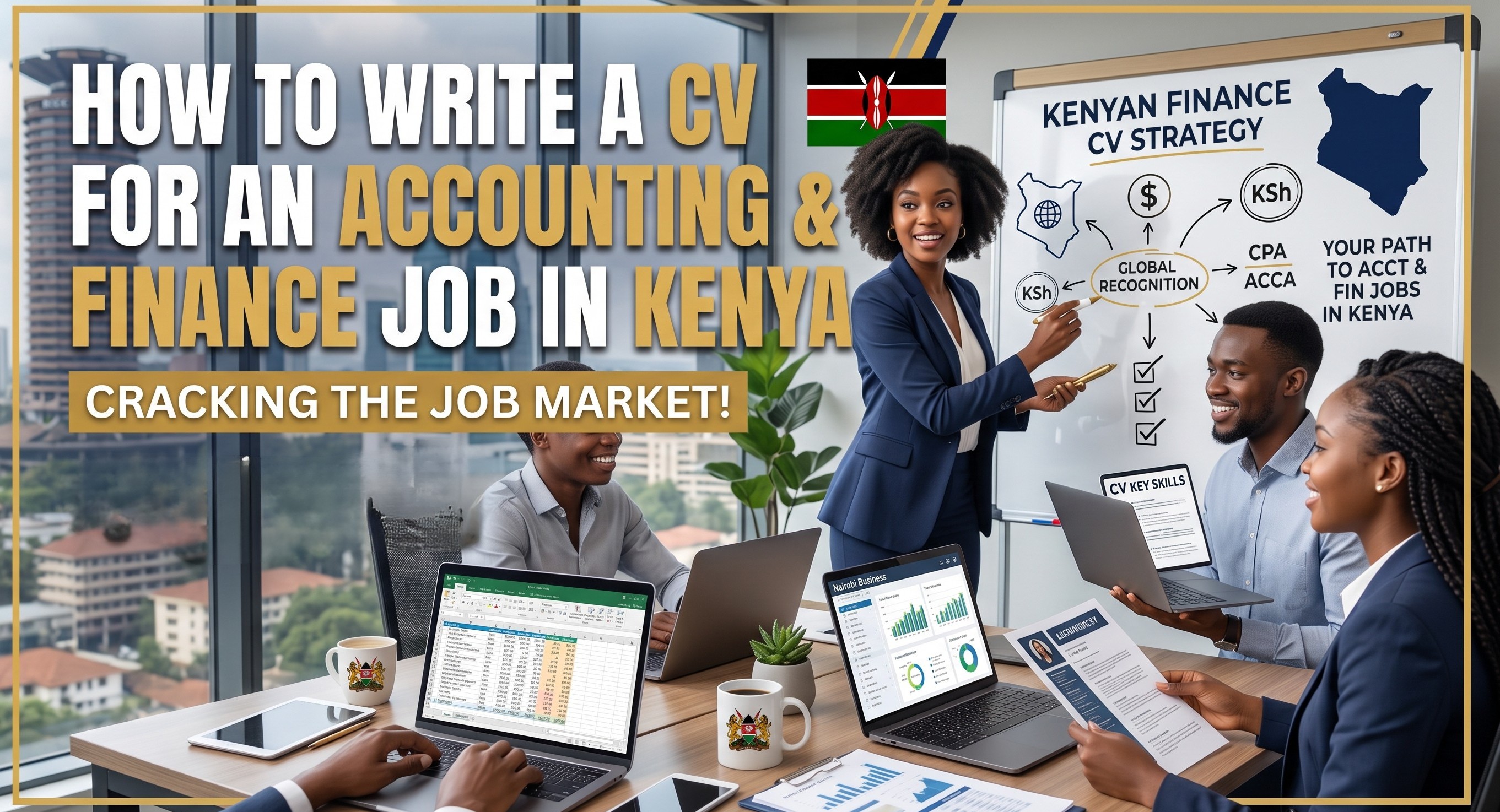
An accounting or finance CV in Kenya should lead with your CPA/ACCA status, the accounting systems you know, and quantified results such as cost savings or improved recovery rates. Finance recruiters in Kenya scan for CPA progress, systems skills, and measurable savings — in that order. Precision and numbers signal competence, so here is how to build a CV that reads as credible from the first line.
What do finance recruiters check first?
Finance and accounting recruiters in Kenya read a CV differently from most sectors — they're looking for proof of qualification and precision before anything else. In roughly this order, they scan for:
- Professional qualification status — your CPA progress (Part I / II / III, or CPA-K / finalist) or ACCA level. In Kenya, CPA is the currency of the profession, and where you are in it is often the first filter.
- Systems and technical skills — the accounting software and tools you actually use: QuickBooks, Sage, SAP, ERP systems, advanced Excel.
- Measurable results — evidence you improved something: cost savings, faster reconciliations, higher recovery rates, cleaner audits.
- Relevant experience and sector — audit, tax, financial reporting, credit, treasury, management accounting, and the industry you've worked in.
- Attention to detail — ironically, a CV with a typo or a maths error in a finance application is close to fatal. The document itself is a test.
Make those first three impossible to miss, and your CV clears the initial screen most applicants fail. The same principle applies across sectors — see our guide on how to write a CV in Kenya for the general framework.
Certifications and systems to list
This is where finance CVs win or lose. Be specific and complete — vagueness reads as weakness in this field.
Certifications and qualifications — list them precisely:
- CPA (state the exact stage — e.g. "CPA-K" or "CPA Part II"), ACCA (with level), or CFA if relevant
- Your degree or diploma in accounting, finance, commerce, or economics
- ICPAK membership status, if you're a member
- Relevant short courses (IFRS, tax, financial modelling)
Systems and technical skills — name the actual tools:
- Accounting software: QuickBooks, Sage, SAP, Oracle, ERP systems
- Advanced Excel (state it, since it's assumed but still expected)
- Any tax or payroll systems (e.g. iTax familiarity), and data tools if relevant
Don't write "good with accounting software." Write exactly which ones. A recruiter matching you to a role that runs on Sage wants to see "Sage" on your CV.
Quantifying your finance achievements
Finance is the sector where numbers on your CV matter most — because numbers are the job. Never describe duties; describe measurable outcomes.
- Weak: "Responsible for debt collection." → Strong: "Improved debtor recovery rate from 68% to 89% over two quarters, recovering KSh 4.2M in overdue accounts."
- Weak: "Prepared financial reports." → Strong: "Produced monthly management accounts for a 5-branch business, cutting reporting turnaround from 15 days to 6."
- Weak: "Handled reconciliations." → Strong: "Reconciled daily transactions across 3 bank accounts with zero variances over 18 months."
- Weak: "Assisted with audits." → Strong: "Supported an external audit that closed with no major findings, preparing all lead schedules."
If you don't have exact figures, use honest, defensible ones ("reduced reporting time by roughly half"). But leave the numbers out entirely and your CV reads like everyone else's.
Structuring the CV
Lead with qualification and capability, and keep it precise and ATS-friendly:
- Contact details — name, phone, professional email, location. No photo.
- Professional summary (2–3 lines) — your qualification status, specialism, and strongest quantified result. Example: "CPA-K finance professional with 4 years in management accounting, having cut monthly reporting time by 60% and recovered KSh 4M+ in overdue debt."
- Professional qualifications & certifications — high on the page; this is your headline asset.
- Key skills & systems — the specific software and technical competencies.
- Professional experience — reverse chronological, each bullet led by a quantified achievement.
- Education.
- Referees — a manager or senior who can vouch for your numbers.
Keep it to two pages, single-column, standard headings — large Kenyan employers and audit firms screen CVs with software before a human reads them, and finance roles are competitive.
| Finance CV done right | Finance CV that gets screened out |
|---|---|
| CPA/ACCA stage stated exactly | Vague "pursuing CPA" |
| Specific systems named (Sage, SAP…) | "Good with accounting software" |
| Achievements quantified in KSh and % | Lists of duties |
| Zero errors, clean and precise | A typo or maths slip (fatal here) |
| Tailored to the specific role | One generic CV for every job |
Tailoring a finance CV — surfacing the right qualification stage, the systems the role uses, and the achievements that match the job — is precise work, and exactly what gets you shortlisted. KaziKit does it for you: paste the job advert and get a CV that leads with your CPA/ACCA status, names the relevant systems, and frames your results in numbers, in under 2 minutes for KSh 25 via M-Pesa. And as a full career companion, KaziKit also sends matched finance and accounting roles to your WhatsApp, and preps you for the interview.
In finance, your CV is your first audit — and recruiters are checking whether it's accurate, precise, and backed by evidence. Lead with your qualification, name your systems, quantify everything, and tailor it to each role.
Related articles
- How to write a CV for a sales job in Kenya
- How to write a CV for a customer service job in Kenya
- Best CV builder in Kenya (2026): honest comparison
Applying for a finance role? Paste the advert into KaziKit and get a precise, numbers-led CV tailored to that job in 2 minutes — KSh 25 via M-Pesa, no app needed. → kazikit.co.ke/cv